Shrubs     White     Pink/Red     Blue/Purple    Yellow   Nonnative
Showing posts with label white. Show all posts

Wednesday, June 5, 2013

Winding Mariposa Lily - Calochortus flexuosus

 I was taken aback to see this delicate flower from the Lily Family (Liliaceae) gracing a dry, gravelly slope above a road cut. This is winding mariposa lily (Calochortus flexuosus), found in the southwestern U.S. Flower petals range from white to pink and have a band of yellow low on them.

Although I only found a few of these flowers scattered, they can grow in large numbers, as seen on the Southwest Colorado wildflowers page.

Sunday, April 8, 2012

Anderson's Buttercup - Ranunculus andersonii

 This was my first native wildflower I saw this year. I didn't know what it was, which I have to admit, made it extra special. Thanks to my friend Glenn, I learned it's Anderson's buttercup (Ranunculus andersonii) a member of the Buttercup Family-Ranunculaceae.

 It grows in the western U.S. and prefers sagebrush areas. The petals can be white or pinkish. The stamens and pistils are yellow. The flower is borne on a leafless stalk. The leaves are usually in a basal rosette, with three double-lobed leaflets at the end of a petiole.


 For more info about Anderson's buttercup, click here.

It sure feels good to have a new flower to add to this blog!

Saturday, July 9, 2011

Red Creek Buckwheat - Johanneshowellia puberula

 This pretty member of the Buckwheat Family (Polygonaceae) is Red Creek buckwheat (Johanneshowellia puberula), with a previous genus name of Eriogonum. It grows only in Utah, Nevada, and California from valley bottoms up to the pinyon-juniper community.

Flowers are small and turn into little red berries. For more info about Red Creek buckwheat, click here.

Friday, July 8, 2011

Coyote Gilia - Aliciella triodon

 This branching plant a few inches high (up to 13 cm) is coyote gilia (Aliciella triodon), and formerly with the genus name Gilia. It's in the Phlox Family (Polemoniaceae) and grows in gravelly substrates in pinyon-juniper areas in the southwestern U.S. Flowers are white and each petal is three-lobed.

For a description of coyote gilia, click on the Jepson manual treatment.

Tuesday, July 5, 2011

Fendler's Sandmat - Chamaesyce fendleri

 This low growing plant is in a family not yet shared on this blog, the Euphoriabeceae, or Spurge Family. It's called Fendler's sandmat (Chamaesyce fendleri), with a previous genus name of Euphorbia. It grows at lower elevations in the western U.S.

For more info about Fendler's sandmat from Southwest Colorado Wildflowers (a great resource), click here.

Saturday, July 2, 2011

Nevada Bedstraw - Galium hypotrichium subsp. nevadense

 Another bedstraw, this one called Nevada bedstraw (Galium hypotichium subsp. nevadense).  This member of the Madder Family (Rubiaceae) grows in Nevada and Utah in pinyon-juniper areas and higher. Leaves are in whorls, the plant is about 20 cm high, and small white flowers are found on the upper half.

 The species is dioecious, with male flowers (above) on some plants, and female flowers (below) on other plants. The female flowers are much easier to photograph!

For more info on Nevada bedstraw from the USDA Plants Database, click here.

Thursday, June 23, 2011

Threepetal Bedstraw - Galium trifidum ssp. columbianum

 This is a tiny plant that grows in wetlands, but it looks much like the larger version that is common, stickywilly or common bedstraw. This is threepetal bedstraw (Galium trifidum ssp. columbianum). It grows in western North America. The plants were only about three-four inches high.

 Flowers have three petals and later a dark fruit will appear.

For more info on threepetal bedstraw from the USDA plants database, click here.

Thursday, June 16, 2011

Tuber Starwort - Pseudostellaria jamesiana

 This pretty white flower in the Pink Family (Caryophyllaceae) is tuber starwort (Pseudostellaria jamesiana). It grows in several western states. The common name is due to the plant spreading from its underground tubers.
 Leaves are just slightly sticky and very narrow.

For more info on tuber starwort, click here.

Tuesday, June 7, 2011

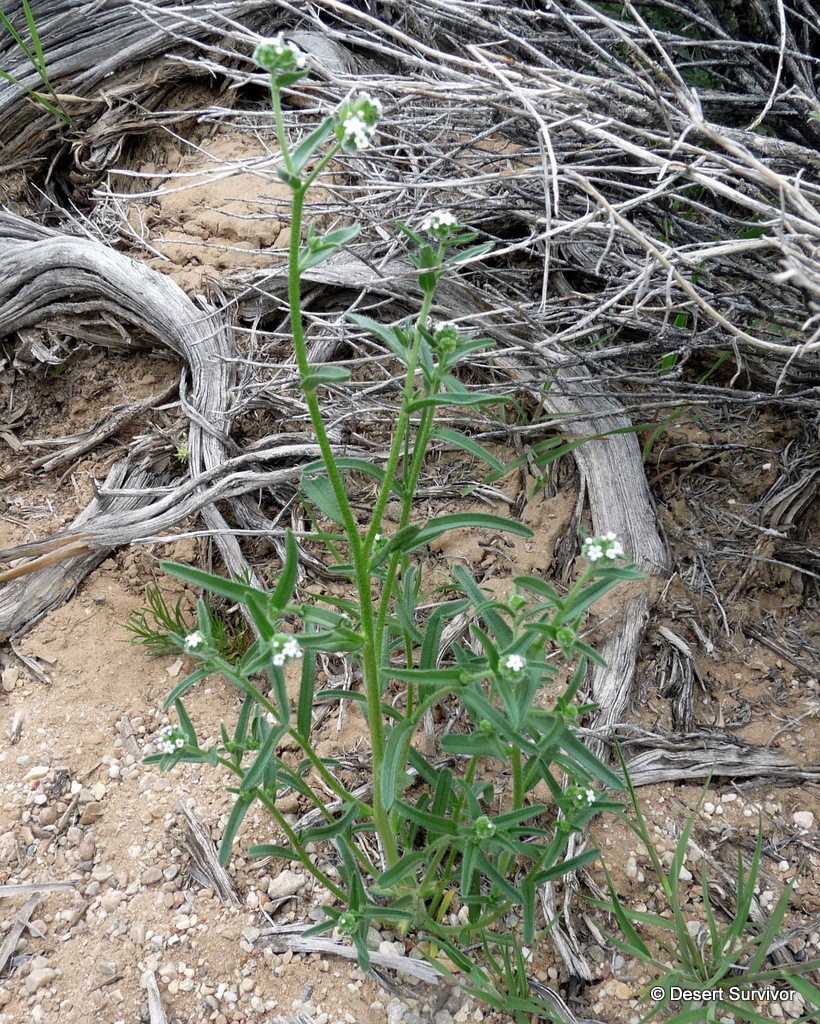
Prickly Cryptantha - Cryptantha echinella

When I saw this cryptantha, I thought it looked a little different--longer leaves. It turns out the leaves are one of the distinguishing characteristics--they have very long hairs on them, hence the name prickly cryptantha (Cryptantha echinella). This species grows at mid-elevations in Nevada, California, Idaho, and Oregon.
To see the USDA Plants Database page about prickly cryptantha, click here. 

Saskatoon Serviceberry - Amelanchier alnifolia

 The large shrub or small tree with red bark, oval leaves, and white flowers in May or June in this area is Saskatoon serviceberry (Amelanchier alnifolia). Flowers have five petals, as is common in the Rose Family (Rosaceae). After the white flowers have finished blooming, small fruits, called pomes grow. The top half of the leaf is toothed.

The trees grow in openings in forests and in sage steppe.

To see some info from the Washington Native Plant Society about Saskatoon serviceberry, click here.

Monday, June 6, 2011

Jones' Fleabane - Erigeron jonesii

Lots of Erigeron are blooming, and we have 17 species in our area. This one is Jones' fleabane (Erigeron jonesii). It grows at mid-elevations in Utah, Idaho, and Nevada.

It has both ray and disk flowers.

The leaves are the distinguishing characteristics. Most are basal, but there are some on the stem. They are hairy. The basal leaves have three obvious nerves.

There's not much other info on Jones' fleabane on the Internet right now, but you can connect to the Plants Database description by clicking here.

Saturday, June 4, 2011

Wild Crab Apple - Peraphyllum ramosissimum

 This large bush with white flowers is wild crab apple (Peraphyllum ramosissimum), sometimes called squaw apple. Later in the summer small apple-like fruits are produced. Wild crab apple grows in several western states, favoring mid-elevations. It's been around a long time, with fossil records of it 50 million years ago. Leaves are oblong and flowers have five white petals, as is common in the Rose Family (Rosaceae).

To learn more about wild crab apple from Southwest Colorado Wildlflowers, click here.

Wednesday, June 1, 2011

Musk Phlox - Phlox hoodii ssp. muscoides

This phlox caught my eye, and even though I thought I had already photographed it, I hadn't. So I guess it's good for me to take a lot of photos now and then! The key had it listed as a separate species, but the USDA Plants Database has it as a subspecies. So we'll call it musk phlox (Phlox hoodii ssp. muscoides), previously Phlox muscoides. It grows in the western U.S. and makes these mounds of flowers. I found it about 6,500 feet elevation.

And here's the ant eye's view
.
For more info on musk phlox, click here.

Sunday, May 29, 2011

Spotted Stickseed - Hackelia patens

This pretty flower is a member of the Borage Family (Boraginaceae) and is called spotted stickseed (Hackelia patens). It grows in several western U.S. states in openings in sagebrush at a wide variety of elevations.

The plant is tall, up to about two feet tall, with the white flowers with blue tinge occurring in clusters.

For more info on spotted stickseed, click here.

Wednesday, May 25, 2011

Field Pepperweed-Lepidium campestre


This non-native weed from Europe is field peppeweed (Lepidium campestre), one of the many members of the Mustard Family (Brassicaceae) that has made its way across the ocean. It now grows in much of North America in disturbed areas.


Flowers are white with four petals.

The leaves are an important distinguishing feature--they clasp the stem.


For more info on field pepperweed, click here.

Sunday, May 22, 2011

Cushion Buckwheat - Eriogonum ovalifolium

When I was uploading these photos I found I had some from last year, like the one above. It's been difficult finding new flowers for this blog, but what I have found is that I have some photos of species that I haven't yet identified, some due to time, some due to difficulty.

Nevertheless, this little white puffball has now found its way onto this blog. It's cushion buckwheat (Eriogonum ovalifolium), a member of the Buckwheat Family (Polygonaceae).

The buds are quite pink, then the flowers are usually white, but get pinker with age. The leaves are distinctive, with their wavy pattern.

The species name ovalifolium is Latin for oval-shaped. Cushion buckwheat grows in western North America and has about 11 varieties.

For more information about cushion buckwheat, click here.

Monday, May 16, 2011

Bearded Cryptantha - Cryptantha barbigera

This low elevation cryptantha that is extremely hairy is called bearded cryptantha (Cryptantha barbigera). It grows in the southwestern U.S. and blooms in May in our area. It's up to about a foot high, and with the tiny white flowers can easily be overlooked.

For more info on bearded cryptantha, click here.

Sunday, May 8, 2011

Narrowstem Cryptantha - Cryptantha gracilis

I'm seeing cryptantha all over the place, mostly Cryptantha pterocaya, Cryptantha flavoculata, Cryptantha confertiflora, and Cryptantha circumscissa, all of which I've blogged about. This one is different, and I think it's Narrowstem Cryptantha (Cryptantha gracilis). The key examines the nutlets in great detail. The nutlets come out after the flowers, which make that tricky. If I don't have this identification right, please leave a note in the comments.

Narrowstem cryptantha grows on rocky slopes from 5500 to 6500 feet in our area in May and June. It's found throughout western U.S.

For more info on Narrowstem cryptantha, click here.

Sunday, May 1, 2011

Longbeak Streptanthella - Streptanthella longirostris

This neat looking plant in the Mustard Family (Brassicaceae) (note the four petals) is longbeak streptanthella (Streptanthella longirostris). The genus name means twisted flower in Greek, while the species name means long-beaked. The seeds become long and pointy.

   The flower is an early bloomer (April-May) and found across the western U.S. It grows at lower elevations, in sagebrush and shadscale shrub areas.

This flower has a close cousin, Streptanthus, also found in the area, but the leaves for it are wider and clasp the stem. Below you can see the narrow leaves of Streptanthella.

For more info on Longbeak Streptanthella, click here.