



 This inconspicuous flower growing on gravelly areas is part of the Phlox Family (Polemoniaceae). It's eyed gilia (Gilia ophthalmoides), and grows in the western U.S. The corolla (yellow and lavender parts) extends far from the calyx (red-striped part that covers the bottom of the corolla).


 For more info about Shockley's rockcress, click here.
 This bright blue flower growing along a streambank caught my attention. The six petals were a hint that it's in the Iris Family (Iridaceae). This is stiff blue-eyed grass (Sisyrinchium demissum), and it grows in many of the desert southwest states. The plant looks very much like a grass until it flowers, hence the common name.
 For more info about stiff blue-eyed grass, click here.
 This pretty alpine flower is moss campion (Silene acaulis). It flowers in July, growing in western and northern North America. It's a member of the Pink family (Caryophyllaceae), and grows in mounds, with last years growth diminished to grey areas.
 For more info about moss campion, click here.
 This prickly thistle grows from desert scrub up to the upper conifer forest. It's called Jackson Hole Thistle (Cirsium subniveum, also Greene's Thistle, Cirsium inamoenum by Flora of North America). Apparently the name confusion is partly due to some unresolved topics about this species. Sometimes plants can be funny like that. Despite botanists not being able to decide what to do with it, the Jackson Hole Thistle has decided to take up residence in many of the western states.
 This is a view looking down on it.
 The flowers can be white to lavender.
 This high elevation columbine is so beautiful I had to take a lot of photos of it! It's Utah columbine (Aquilegia scopulorum), part of the Buttercup Family (Ranunculaceae). As you might guess, it grows in Utah, along with Nevada, Colorado, and Wyoming.
 It has long spurs that protrude behind the flower, and the leaves have a bluish tinge and are in tight mats.
 Bees and butterflies pollinate these columbine, and you can find an interesting natural history about how Aquilegia crossed the Bering land bridge 10,000 to 40,000 years ago here.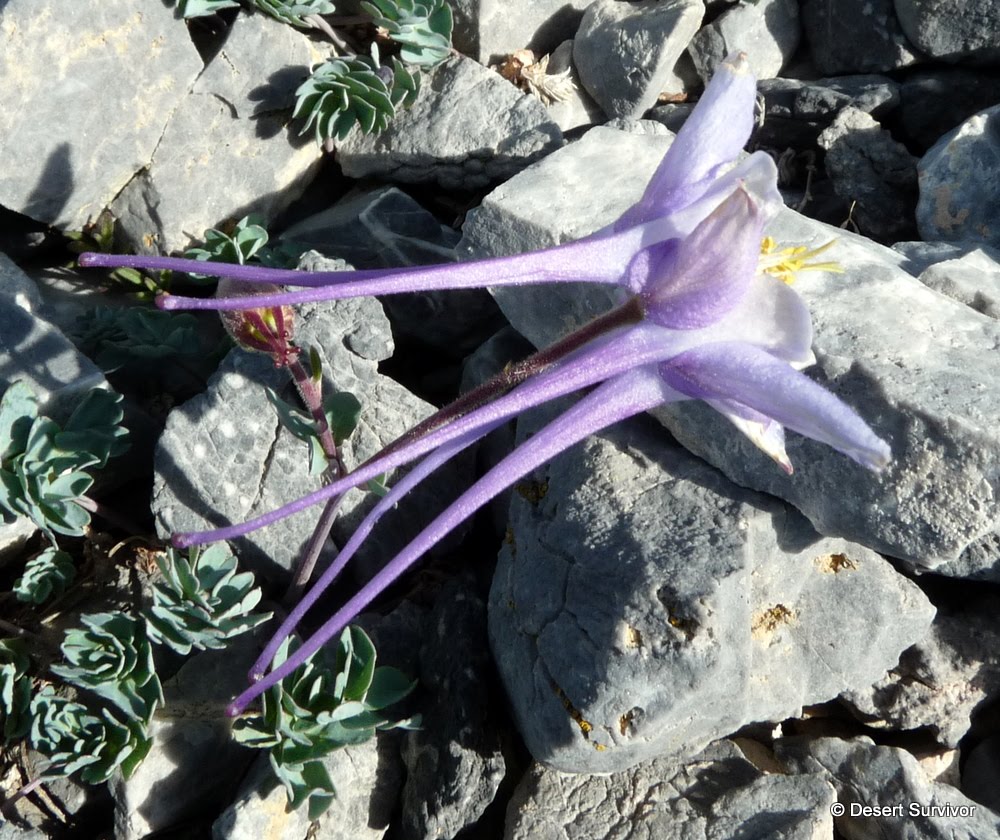
 For more info about Utah columbine, click here.
 This is another riparian plant, in fact you might have glimpsed in it the last post. With thick stems and small purple flowers, this is American speedwell (Veronica americana), part of the Figwort Family (Scrophulariaceae). Another common name is American brooklime. It's native to parts of North America and Asia.
 Flowers have four petals.
 For more information about American speedwell, click here.
 This inconspicuous little flower is Flat-top Broomrape (Orobanche corymbosa), part of the Broomrape Family (Orobanchaceae). We have four species in this family in this area.
 It's easy to miss the flower, which is tubular with wooly anthers.
 Although the plant is native to most of the western U.S., it is considered a noxious weed in some areas.
 This spreading plant often found in disturbed areas is bigbract verbena (Verbena bracteata), the only member of the Verbena Family (Verbenaceae) in this area. It's also called prostrate vervain.
 Stems are hairy and leaves are opposite. The flowers have five lobes.
 For more information about bigbract verbena, click here.
 This attractive blue flower is silvery lupine (Lupinus argenteus), a member of the Pea Family (Fabaceae). It is native to western North America and grows in sagebrush, grasslands, and forests.
 Flowers are clustered and bright blue.
 This long-flowering plant can grow up to 3 feet tall.
 Here's another penstemon, this one clearly different from yesterday's in the way the flowers line up and down the petiole. This smoothleaf beardtongue (Penstemon leiophyllus variety francisci-pennelli). This variety is found only in Nevada and above 8,000 feet. The species is only found in Utah and Nevada. The stem is glabrous (smooth) and the corolla slightly hairy.
 There isn't much info out there about smoothleaf beardtongue, but you can see the USDA Plants profile if you click here.
 We have a lot of penstemons in the area, and I believe this one is low beardtongue (Penstemon humilis). The flowers are dark blue with a white interior, the stems are slightly hairy as is the corolla, and the calyx is shorter than the corolla tube, and the staminode is hairy at the apex. My only problem is that the photos I see on the internet show taller plants with more flowers per petiole, so if anyone has a different i.d., please let me know.
 It's found from about 6,000 to 11,000 feet and blooms mid-summer. For more info about low beardtongue, click here.
 This dainty Pea Family (Fabaceae) flower is spiny milkvetch (Astragalus kentrophyta). It grows above 10,000 feet in elevation, and is native to western North America. It has pointy leaves that somewhat resemble spikes.
 Growing up to six feet tall in moist area and producing dark purple flowers is Columbian monkshood (Aconitum columbianum). It's a member of the Buttercup Family (Ranunculaceae), although the lower leaves on the plant look almost maple-like.
 The flowers supposedly resemble monk's hoods, hence the common name.
 The petals of the plant are actually inside the protective covering formed by the sepals, along with the reproductive parts. A bee pollinates this highly specialized flower.
 I saw buds, flowers, and seed pods all in the same area, showing the different stages all at one time.
 Only one species of Aconitum grows in this area, making it fairly easy to identify. It also can form short vines, making it more distinctive.
 The tall, purplish colored flowers that decorate roadsides and other disturbed locations late in summer is Rocky Mountain beeplant (Cleome serrulata). Despite its common name, this plant is found throughout most of North America, although in some areas it's considered weedy or invasive. It's a member of the Caper Family (Capparaceae), and also goes by the name bee spiderflower.
  Clusters of flowers with four petals and six stamens are found at the end of the stalk. Seed pods are elongated.
  Intermixed with the purplish flowers were a few white ones. I'm not sure what causes the color change.
 The flowers look exactly the same except for a different color.

