



 One of the common names for this plant is saltlover (Halogeton glomeratus); its genus name Halogeton is Greek for salt neighbor, and is often used as the common name. It's nonnative, found in salty soils, and is considered in many areas to be a noxious weed. It grows throughout much of the western U.S. It concentrates sodium oxalate and is poisonous to livestock.
 The stems are often red, and the flowers are small and inconspicuous.
 You might not recognize this plant by its USDA Plants Database name: burningbush (Bassia scoparia formerly Kochia scoparia), but you might know it by its other common names, kochia, ragweed, summer cypress, fireball, and Mexican fireweed. It's native to Eurasia but is now widespread. Although many consider it a weed, it does have some forage, food, ornamental, and erosion control properties.
 For more info on burningbush, click here.
 This is my least favorite weed: puncture vine (Tribulus terrestris), also known as goathead or caltrop.
 The cute ferny leaves and pretty yellow flowers are deceiving, making it seem like a friendly plant. Puncture vine is in the Zygophyllaceae family, also known as the creosote bush family. My husband's favorite plant is creosote bush, so how is it possible that my least favorite plant is in the same family?
 Puncture vine is originally from the Mediterranean, but it has spread quickly. These trailing tendrils make it obvious why someone decided to call it a vine. What about the puncture part? Take a look at this next photo.
 These little green fruits are fairly innocuous early in the summer, but the heat and dryness of hot days makes them get harder and harder...
 ...until they turn into sharp brown thorns that break apart and make even more sharp brown thorns. These thorns are so sharp that I've gotten a flat bicycle tire, a flat stroller tire, and a flat wheelbarrow tire. Needless to say, all of these tires now contain Slime.
 While I was photographing the puncture vine, Desert Boy took a fall, landing right on top of a mass of it. He started crying immediately and I think he's joined me in calling this his least favorite weed.
 Here are a couple of the thorns stuck in his hand. The seeds remain viable for three to seven years, so even though I have pulled every plant that I've seen in the yard, I'll probably have to keep after them for years. And unfortunately there are plenty of seeds just outside our yard.
 This grass is easy to identify due to its dense cyclindrical inflorescence. It's timothy (Phleum pratense), native to Europe but frequently found in many other parts of the world due to its use in agriculture. Wildlife also find it palatable.
 It grows up to three feet tall.
 For more info on Timothy, click here.
 This tall spreading plant in the pea family (Fabaceae) growing along roadsides is white sweet clover (Melilotus albus). It is native to Europe and Asia but was brought to North America in the 1600s and has become invasive. It is sometimes included with Melilotus officinalis, the yellow-flowered similar looking plant.
 The flowers are white and grow in tall, narrow clusters.
 For more information about white sweet clover, click here.
 This non-native plant that often grows in disturbed areas is hoarhound (Marrubium vulgare), a member of the mint family (Lamiaceae). It has square stems and opposite leaves. It is native to Europe, Asia, and northern Africa and brought over to the U.S. as a garden plant with various medicinal properties. However, it escaped gardens and now grows out in the wild.
 The small white flowers are followed by burs with hooks that can catch on anything that brushes up against them.
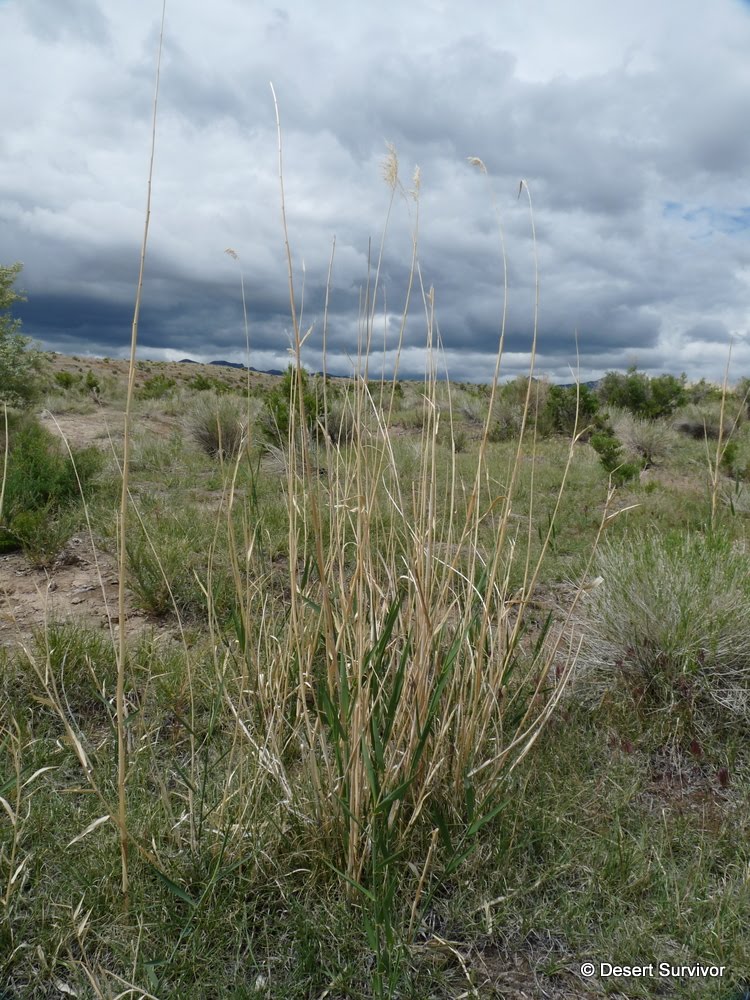 A rather large member of the Grass Family (Poaceae) is the common reed (Phragmites australis), often called Phragmites. It can grow up to about fifteen feet tall and often grows in dense stands in wet areas. There is some debate over whether the species is native or not, but it appears that the more aggressive, invasive variety is from Europe.
 Old seed heads look fluffy and bend over. New ones are produced in July and are brownish in color.
 New growth emerges from the old growth, creating a thick mat of vegetation that is difficult to penetrate.
 This shrub/tree with the pretty pink flowers is actually a big pain in the butt throughout many of the southern states in the U.S. This is saltcedar (Tamarix ramosissima), also called tamarisk. It is the only member in its family, the Tamarisk Family (Tamaricaceae) found here. It is native to Eurasia.
 For more information about salt cedar, click here.
 A tree that can often grow in the desert where no other tree can grow might seem good at first, but it's turned out to be quite a nuisance. This is Russian olive (Elaegnus angustifolia), in the Oleaster Family (Elaeagnaceae). It was brought to the U.S. as a windbreak and has gone on to break many people as they try to remove it. It is thorny, grows rapaciously in wet areas, and can quickly out compete native vegetation.
 The flowers are yellow, and later in the summer it will have dark-colored fruit that can float down streams and propagate this invasive species in other locations. The flowers have a strong smell. For lots more about Russian olive, click here.
 Here's another easy member of the Grass Family, easy because it is so widespread. This is cheatgrass (Bromus tectorum), an annual weed. It is a bad, bad plant, adapted to a wide variety of habitats, and no one knows how to control it.
 For more information about cheatgrass, click here.
 This unusual looking plant with the clasping leaves is in the Mustard Family (Brassicaceae) and is called clasping pepperweed or clasping peppergrass (Lepidium perfoliatum). Unfortunately it's nonnative.
 Although most of the leaves on the stem are clasping, the basal leaves and lower stem leaves may be divided. The tiny flowers are yellow.
 For more information about clasping pepperweed, click here.
 Another common weed around my house is prickly lettuce (Lactuca serriola), a member of the Aster Family. It is native to Europe but now found through much of North America. It reproduces by seeds.
 The flowers are yellow, with indentations on the ray flowers.
 Each plant can have many flowers and even more seeds.
 Continuing with the theme of weeds around my yard, today we've got field bindweed (Convolvulus arvensis), also called morning glory. It's a member of the Morning Glory Family (Convolvulaceae), and although it's common throughout North America, it is not native and many states consider it a noxious weed. The pretty flowers that open daily grow along a vine that quickly entangles itself around other vegetation, fences, and whatever gets in its way.
 Standing erect with seed pods that become more obvious during the summer as they turn browner is curly dock (Rumex crispus), a member of the Buckwheat Family (Polygonaceae). It's native to Eurasia, but is now common throughout North America.
 As the seed pods age, they turn from green to pink.
 And then to an orangish-brown.
 One of the weeds that I find all too frequently in my garden is common mallow (Malva neglecta), a member of the Mallow Family (Malvaceae). It has deep roots, so I have to pull hard to remove it.
 Each stem supports multiple leaves and some rather pretty flowers. It is native to Europe but has become a weed in most of North America.


