Shrubs     White     Pink/Red     Blue/Purple    Yellow   Nonnative

Saturday, May 2, 2020

Siberian Elm - Ulums pumila

 Siberian elm (Ulmus pumila) is a relatively common tree around Great Basin towns, as it is easy to grow and doesn't need much water. Sometimes they find their way outside of towns, like this specimen. In other areas they can become a nuisance. In the spring they make little seed pods that attract a lot of birds. Siberian elm is our only species in the Elm Family (Ulmaceae) found in Snake Valley.

Trees generally don't get very large. For more info, see the Invasive Plant Atlas.

Saturday, April 25, 2020

Narrowleaf Willow - Salix exigua

This shrub or small tree can create quite a thicket along a creek. It's one of several willows in the area. The narrow, long leaves are a defining feature for Narrowleaf Willow (Salix exigua), sometimes called Coyote Willow. It's in the Willow Family (Salicaceae). 

The catkins appear in spring. Willows have been used extensively by native peoples for a variety of reasons, including medicinal.
For more info on narrowleaf willow, see this USU Extension webpage.

Thursday, April 23, 2020

Curl-leaf Mountain Mahogany - Cercocarpus ledifolius

 
Curl-leaf Mountain Mahogany (Cercocarpus ledifolius) is a small tree or shrub in the Rose Family (Rosaceae). It has dense wood and waxy green leaves. 

Generally the plant looks like the photo below, mainly green with grey stems. The trees can live for over a thousand years in some places.
 

However, in the spring, small yellow flowers emerge.

The flowers eventually develop into seeds that are nicknamed hellfeathers, because if they spiral down inside your shirt, you might be saying a few expletives. 
For more info on Curl-leaf mountain mahogany, see this Wikipedia page.

Tuesday, April 21, 2020

Skunkbush Sumac - Rhus trilobata

Woohoo, after a many-year break, this blog is going again. With the 2020 Coronavirus Pandemic, it's time to #ExploreYourBackyard. So instead of the far-flung trips I had planned, I'm learning my backyard and nearby areas super well. 

That includes documenting what plants are flowering. (Check out the Snake Valley Trails Partnership Facebook Page for some recent finds.)

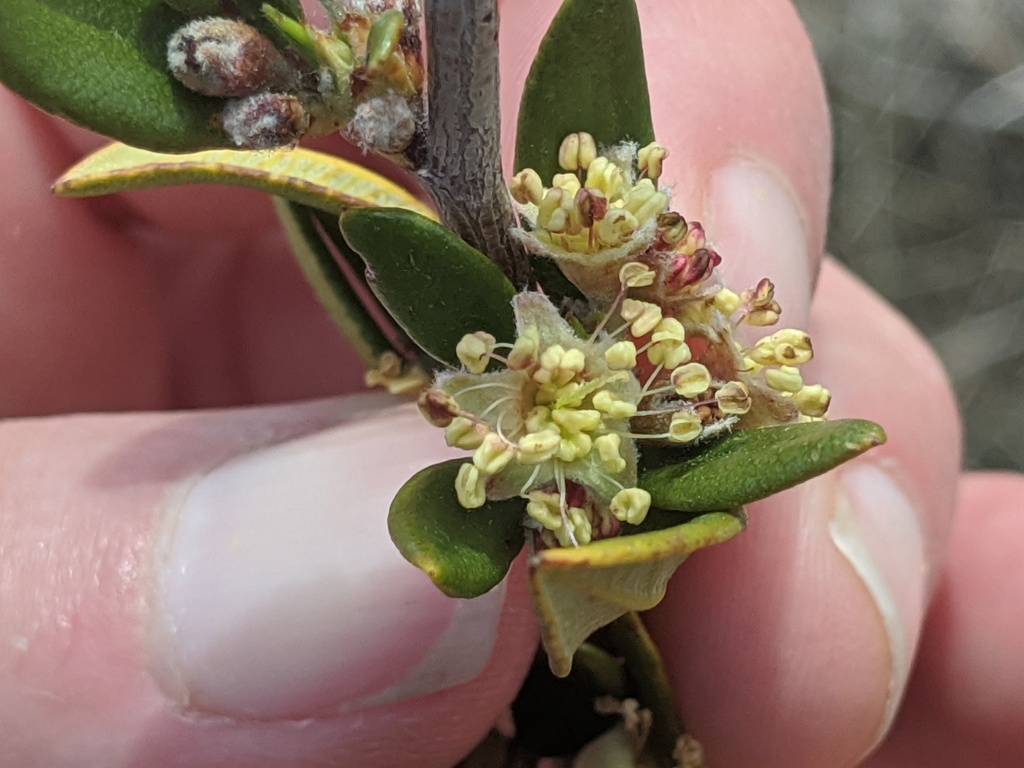
The yellow on this bush called my attention on a recent walk on the Sagebrush Discovery Trail. I went over and took a look. All I saw were tiny flowers in clusters at the ends of the twigs. No leaves. But I remembered something about where these bushes were. This had to be Skunkbush Sumac (Rhus trilobata), the bush that has bright red berries and the leaves turn beautiful colors in the fall! 


It's in the Sumac or Cashew Family (Anacardiaceae), the same family as poison ivy. Fortunately, the bush doesn't (usually) lead to a rash. You can see the lobed, compound leaves (in threes, just like poison ivy).


The leaves are gorgeous in the fall.
For more info on skunkbush sumac, check out this cool Utah State University Extension publication.

Wednesday, June 5, 2013

Winding Mariposa Lily - Calochortus flexuosus

 I was taken aback to see this delicate flower from the Lily Family (Liliaceae) gracing a dry, gravelly slope above a road cut. This is winding mariposa lily (Calochortus flexuosus), found in the southwestern U.S. Flower petals range from white to pink and have a band of yellow low on them.

Although I only found a few of these flowers scattered, they can grow in large numbers, as seen on the Southwest Colorado wildflowers page.

Tuesday, June 4, 2013

Toano Milkvetch - Astragalus toanus


I saw a pink flowering bush along the side of the road in southern Snake Valley and stopped to take a closer look. Imagine my surprise when I found little pea-like flowers on it! What kind of plant in the Pea Family (Fabaceae) grows in a bush? Turns out it's Toano milkvetch (Astragalus toanus). It only grows in a few western states, prefers the valley floors, and blooms in May and June.


To see the USDA Plants database entry on Toano milkvetch, click here.

Saturday, June 1, 2013

American Yellowrocket - Barbarea orthoceras

 This member of the Mustard Family (Brassicaceae) with its four-petaled yellow flowers is American yellowrocket (Barbarea orthoceras). It grows in much of western and northern North America.

For more information on American Yellowrocket, click here.

Sunday, May 19, 2013

Arrowleaf Balsamroot - Balsamorhiza sagittata

 This bright yellow flower with wide, arrow-shaped leaves is Arrowleaf Balsamroot (Balsamorhiza sagittata), a member of the Sunflower Family (Asteraceae). It grows below 10,000 feet on open, dry slopes and flats and blooms from May to July.

For more information on arrowleaf balsamroot, click here.

Saturday, May 18, 2013

Steptoe Valley Beardtongue - Penstemon immanifestus

 This beautiful pinkish penstemon is Steptoe Valley Beardtongue (Penstemon immanifestus), part of the Figwort Family (Scrophulariaceae). It grows from 5,000 to 6,000 feet on sandy soils, and I found it near EskDale, Utah. It is only found in Utah and Nevada. It grows about one-foot tall, and flowers are over an inch long. Stems are glabrous (smooth), and the staminode (yellow part in flower above) is bearded (hairy).

Because of it's limited distribution, I couldn't find much info about it. Here's a link to the USDA Plants Database.

Monday, May 13, 2013

Spring Wildflowers in Pole Canyon

Hi! After a year's hiatus, I'm back!

This has been a great spring for wildflowers. Even though we had a rather dry winter, April was fairly wet, and I've been seeing a lot. This year I've been focusing on photographing the flowers in a particular area and then posting them all together. This helps people who are hiking in that area see them all together. It's also helped me to find a few more plants I need to key out and include on this blog.

To see the spring wildflowers along Pole Canyon trail in Great Basin National Park, click here.

Sunday, April 8, 2012

Anderson's Buttercup - Ranunculus andersonii

 This was my first native wildflower I saw this year. I didn't know what it was, which I have to admit, made it extra special. Thanks to my friend Glenn, I learned it's Anderson's buttercup (Ranunculus andersonii) a member of the Buttercup Family-Ranunculaceae.

 It grows in the western U.S. and prefers sagebrush areas. The petals can be white or pinkish. The stamens and pistils are yellow. The flower is borne on a leafless stalk. The leaves are usually in a basal rosette, with three double-lobed leaflets at the end of a petiole.


 For more info about Anderson's buttercup, click here.

It sure feels good to have a new flower to add to this blog!

Tuesday, April 3, 2012

2012

I've been seeing some great spring wildflowers already this year: Indian paintbrush (Castilleja angustifolia), Nevada biscuitroot (Lomatium nevadense), spiny phlox (Phlox hoodii), and more. I will try to get some photos posted soon.

If you don't want to wait, you can see some wildflower photos on my Desert Survivor blog. The wildflowers aren't the focus of those posts, but you'll be able to see where I'm finding them.

Thanks for stopping by. I have about 300 plants featured on this blog--only 700 to go!

Saturday, July 9, 2011

Red Creek Buckwheat - Johanneshowellia puberula

 This pretty member of the Buckwheat Family (Polygonaceae) is Red Creek buckwheat (Johanneshowellia puberula), with a previous genus name of Eriogonum. It grows only in Utah, Nevada, and California from valley bottoms up to the pinyon-juniper community.

Flowers are small and turn into little red berries. For more info about Red Creek buckwheat, click here.

Friday, July 8, 2011

Coyote Gilia - Aliciella triodon

 This branching plant a few inches high (up to 13 cm) is coyote gilia (Aliciella triodon), and formerly with the genus name Gilia. It's in the Phlox Family (Polemoniaceae) and grows in gravelly substrates in pinyon-juniper areas in the southwestern U.S. Flowers are white and each petal is three-lobed.

For a description of coyote gilia, click on the Jepson manual treatment.

Tuesday, July 5, 2011

Fendler's Sandmat - Chamaesyce fendleri

 This low growing plant is in a family not yet shared on this blog, the Euphoriabeceae, or Spurge Family. It's called Fendler's sandmat (Chamaesyce fendleri), with a previous genus name of Euphorbia. It grows at lower elevations in the western U.S.

For more info about Fendler's sandmat from Southwest Colorado Wildflowers (a great resource), click here.

Monday, July 4, 2011

Firecracker Penstemon - Penstemon eatonii

 I've been saving this flower for Fourth of July, as it's common name is Firecracker Penstemon (Penstemon eatonii). It grows in the western U.S. in a variety of habitats.

 Flowers are bright red in narrow tubes.

For more info about firecracker penstemon (and how to use it in your water wise garden), click here.

Sunday, July 3, 2011

Lavenderleaf Sundrops - Calylophus lavandulifolius

 This bright flower in the Evening Primrose Family (Onagraceae) has one of the best common names I've heard: lavenderleaf sundrops (Calylophus lavandulifolius). It grows in gravels from the Plains States west to Nevada.

 Flowers are one to two inches across and bright yellow. As they fade, they turn pinkish or purplish.

For more info about lavenderleaf sundrops, click here.

Saturday, July 2, 2011

Nevada Bedstraw - Galium hypotrichium subsp. nevadense

 Another bedstraw, this one called Nevada bedstraw (Galium hypotichium subsp. nevadense).  This member of the Madder Family (Rubiaceae) grows in Nevada and Utah in pinyon-juniper areas and higher. Leaves are in whorls, the plant is about 20 cm high, and small white flowers are found on the upper half.

 The species is dioecious, with male flowers (above) on some plants, and female flowers (below) on other plants. The female flowers are much easier to photograph!

For more info on Nevada bedstraw from the USDA Plants Database, click here.

Friday, July 1, 2011

Desert Snowberry - Symphoricarpos longiflorus

 This shrub with the oval leaves and pink trumpet-like flowers is desert snowberry (Symphoricarpos longiflorus). It grows through much of western North America.

 I had never noticed before how much the flowers of snowberry resemble those of Ribes  (currant) until this year. After the flowers drop off, white berries will appear.

For more info on desert snowberry, click here.

Thursday, June 30, 2011

Tunnel Springs Beardstongue - Penstemon concinnus

 This beautiful little penstemon is Tunnel Springs Beardstongue (Penstemon concinnus). It only grows in Utah and Nevada in gravelly alluvial soils in pinyon/juniper.  The plant is compact, usually not more than 20 cm tall.

For more info about Tunnel Springs beardstongue, click here.