When I was uploading these photos I found I had some from last year, like the one above. It's been difficult finding new flowers for this blog, but what I have found is that I have some photos of species that I haven't yet identified, some due to time, some due to difficulty.
Nevertheless, this little white puffball has now found its way onto this blog. It's cushion buckwheat (Eriogonum ovalifolium), a member of the Buckwheat Family (Polygonaceae).
The buds are quite pink, then the flowers are usually white, but get pinker with age. The leaves are distinctive, with their wavy pattern.
The species name ovalifolium is Latin for oval-shaped. Cushion buckwheat grows in western North America and has about 11 varieties.
For more information about cushion buckwheat, click here.
Sunday, May 22, 2011
Tuesday, May 17, 2011
Tall Tumblemustard - Sisymbrium altissimum
This four-petaled flower in the Mustard Family (Brassicaceae) is attractive right now, but unfortunately it's non-native to North America, where it is widespread. This is tall tumblemustard (Sisymbrium altissimum). Over the summer it dries out and eventually strong winds can snap the plant down and blow it around, further spreading seeds. Of historical interest, it is thought that early railroads helped distribute this species.
It can grow 3-5 feet high, and leaves are deeply divided at the base.
For more info on tall tumblemustard, click here.
It can grow 3-5 feet high, and leaves are deeply divided at the base.
For more info on tall tumblemustard, click here.
Monday, May 16, 2011
Bearded Cryptantha - Cryptantha barbigera
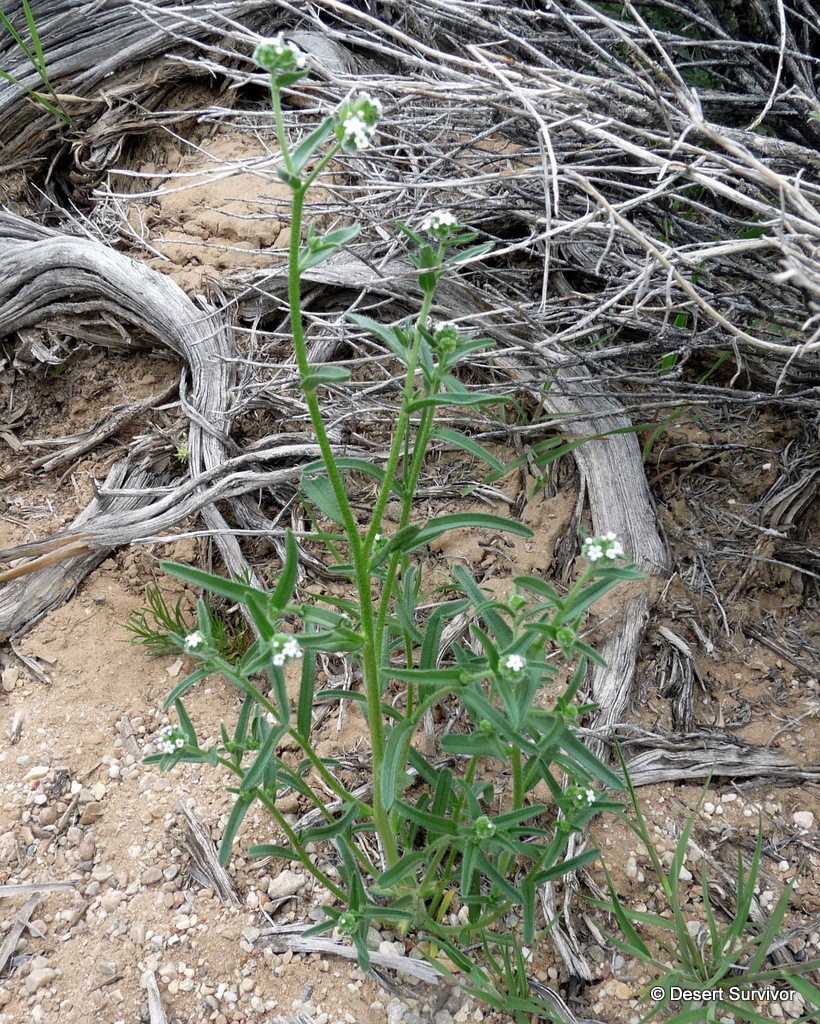
This low elevation cryptantha that is extremely hairy is called bearded cryptantha (Cryptantha barbigera). It grows in the southwestern U.S. and blooms in May in our area. It's up to about a foot high, and with the tiny white flowers can easily be overlooked.
For more info on bearded cryptantha, click here.
Saturday, May 14, 2011
Eyed Gilia - Gilia ophthalmoides
Like most gilia species, eyed gilia has a rosette of basal leaves. For this species, the leaves and stem are very hairy, with some hairs appearing almost like cobwebs.
For more info about eyed gilia, click here.
Sunday, May 8, 2011
Narrowstem Cryptantha - Cryptantha gracilis
I'm seeing cryptantha all over the place, mostly Cryptantha pterocaya, Cryptantha flavoculata, Cryptantha confertiflora, and Cryptantha circumscissa, all of which I've blogged about. This one is different, and I think it's Narrowstem Cryptantha (Cryptantha gracilis). The key examines the nutlets in great detail. The nutlets come out after the flowers, which make that tricky. If I don't have this identification right, please leave a note in the comments.
Narrowstem cryptantha grows on rocky slopes from 5500 to 6500 feet in our area in May and June. It's found throughout western U.S.
For more info on Narrowstem cryptantha, click here.
Narrowstem cryptantha grows on rocky slopes from 5500 to 6500 feet in our area in May and June. It's found throughout western U.S.
For more info on Narrowstem cryptantha, click here.
Monday, May 2, 2011
Western Tansymustard - Descurainia pinnata
This nonnative mustard, western tansymustard (Descurainia pinnata) likes disturbed areas at all elevations below 10,200 feet. It grows throughout North America.
Click here to get to the USDA Plants Database page for western tansymustard, with links at the bottom of it.
Sunday, May 1, 2011
Longbeak Streptanthella - Streptanthella longirostris
This neat looking plant in the Mustard Family (Brassicaceae) (note the four petals) is longbeak streptanthella (Streptanthella longirostris). The genus name means twisted flower in Greek, while the species name means long-beaked. The seeds become long and pointy.
This flower has a close cousin, Streptanthus, also found in the area, but the leaves for it are wider and clasp the stem. Below you can see the narrow leaves of Streptanthella.
For more info on Longbeak Streptanthella, click here.
Subscribe to:
Posts (Atom)